• (203) 757-5000
Elevator Service Company
  • Elevators
    • Traditional Home Elevators
      • Hydraulic Elevators
      • Inline Gear Drive Elevators
    • Luxury Home Elevators
      • Symmetry Asterix
      • Cibes Air
      • Cibes Antera
      • Symmetry Dream
      • Glass Elevators
    • Home Accessibility Elevators
    • Small Footprint Elevators
      • Cibes Ascenda
      • Shaftless Home Elevators
    • Elevator Doors
    • Commercial Elevators
      • LULA Elevator Systems
      • Dumbwaiter
  • Lifts
    • Vertical Platform Lift
      • Cibes Primo
  • Services
    • Home Elevator Installation
    • Commercial Elevator Installation
    • Repairs
    • Evaluations
  • Resources
    • Brochures and Downloads
    • FAQ
    • Blog
  • About
        • Areas We Serve
          • Connecticut
          • New York
          • Rhode Island
          • Massachusetts
        • Partners
        • Testimonials
  • Contact
  • Menu Menu

Why a Shaftless Home Elevator Outperforms a Stairlift for Most Homeowners

When homeowners start thinking about stair access, a stairlift is usually the first option that surfaces. The marketing is heavy, the installation sounds manageable, and the price appears more approachable than a home elevator. But the stair lift vs. elevator question gets more complicated once you take a closer look, and for most buyers who do, the answer changes. With more than 75 years of residential elevator installation experience across Connecticut, New York, Rhode Island, and Massachusetts, ESCO has walked through this comparison with a lot of families. This is an honest look at both options and what actually matters when you’re making this call.

Why Stairlifts Come Up First

Stairlifts are heavily marketed to homeowners searching for mobility solutions, which is why they tend to be the starting point for this conversation. Understanding what they do well and where they fall short is the right way to approach the home elevator vs. stairlift comparison.

What Stairlifts Do Well

A straight-rail stairlift can be installed on a single-flight staircase in a single day, making it one of the fastest mobility solutions available. For a homeowner with moderate limitations who can still sit, stand, and walk a few steps independently, that speed is genuinely useful. A stairlift can fill a real need for a buyer with a straightforward staircase and a shorter time horizon, and that’s worth acknowledging clearly before going any further.

Where the Quote Doesn’t Tell the Whole Story

The stair lift vs. elevator comparison starts to shift the moment a staircase has more than one flight or anything other than a straight run. A curved or multi-landing staircase requires a custom-manufactured rail, and that fabrication cost can push a stairlift project significantly closer to elevator territory than the original estimate suggested. Standard stairlift models also carry weight limits of 250 to 300 pounds, a constraint that affects more buyers than most dealers lead with and that heavy-duty upgrades address only at a considerable additional cost.

The Limitations That Surface After the Sale

Beyond the cost surprises, there are structural limitations built into the stairlift design that no upgraded model solves. These tend to surface after the installation is in, which is the worst time to find them.

The Multi-Landing Transfer

On a home with more than one flight of stairs, a stairlift requires the rider to disembark at the landing, walk across, and board a second unit for the next flight. That transfer is manageable for a buyer with moderate limitations today, but it becomes a genuine safety concern as mobility declines over time. It’s also a problem that can’t be engineered away by upgrading the unit or installing a more capable model. A shaftless elevator moves between floors continuously with no transfer at any level, which is a fundamentally different solution for anyone thinking past the immediate moment.

The Wheelchair Barrier

A stairlift is designed for someone who can independently mount the unit, secure a seatbelt, and dismount at each stop. It doesn’t accommodate a wheelchair or a caregiver providing physical assistance. For buyers who need to plan for either of those scenarios now or at some point in the next decade, a stairlift will reach the end of its usefulness before that need fully arrives. [Residential home elevators](link to ESCO home elevators hub page, confirm URL) address that gap directly: the platform accommodates a wheelchair user and a caregiver in the same ride, with no transfer and no dismounting required at any point.

What Shaftless Elevator Installation Requires

The most common reason homeowners rule out a home elevator without investigating further is the assumption that installation involves major structural disruption. For a traditional cab-style elevator, that assumption has some basis. For a shaftless model, the reality is considerably more approachable.

A Self-Supporting Rail System

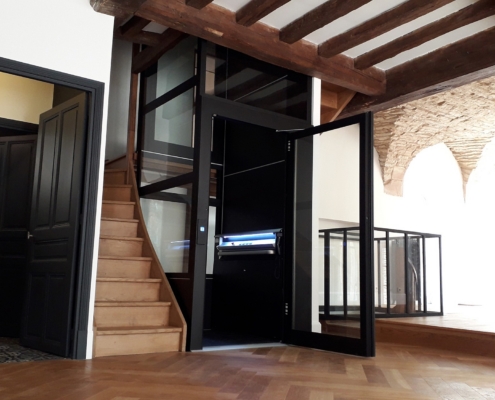
A shaftless home elevator uses a freestanding rail structure with a compact footprint, sometimes as small as 25 square inches of floor space. There’s no pit to excavate, no overhead machine room to build, and no shaft to frame in. Most installations work within the home’s existing layout, take two to three days from start to finish, and don’t require the structural modification most homeowners are imagining when they first hear the words “home elevator.”

What This Means for Older New England Homes

The colonial, cape, and Victorian homes throughout Connecticut, Rhode Island, and Massachusetts create real complications for curved stairlift installs. Narrow original staircases, period millwork, and multi-landing layouts require custom rail fabrication that drives costs up fast and timelines out considerably. Those same homes are frequently well-suited to a shaftless elevator, where the self-supporting rail design fits within existing space without altering the structure. For many New England homeowners, the stairlift vs. elevator cost comparison looks entirely different once they see the actual installation scope for each option side by side.

Knowing how a shaftless elevator fits into your specific home makes the stair lift vs. elevator decision much clearer. The Cibes Ascenda is the shaftless home elevator ESCO installs throughout New England, engineered for existing homes without major construction.

Explore the Cibes Ascenda

The Case for Thinking 10 Years Ahead

The most useful framing for the stair lift vs. elevator decision isn’t “what do I need right now?” It’s “will this still be working for me in 10 years?” Running that test produces a different answer for most buyers, and it’s the lens elevator specialists use when advising homeowners who are planning ahead rather than responding to an immediate need.

How Mobility Needs Evolve

A stairlift is calibrated to a specific window of physical capability. The user still needs to walk to the unit, mount and dismount at each landing, and manage the transfer between floors independently. Each of those requirements gets harder to meet as needs change, and the stairlift’s usefulness declines accordingly. The vast majority of older adults want to stay in their homes as they age, and a shaftless home elevator is the stairlift alternative that supports that goal across a much wider range of ability levels, including scenarios that would otherwise push toward significant home reconfiguration or a move to assisted living.

What Home Buyers See at Resale

Stairlifts are typically removed before a home is listed. In most markets, they read as a temporary accommodation rather than a built-in feature, and buyers can interpret them as a signal about the property’s recent history. A home elevator is a different conversation in the high-value residential markets of Fairfield County, coastal Connecticut, and the upscale suburbs throughout Rhode Island and Massachusetts. In those markets, long-term livability is increasingly treated as a value driver, and a home elevator is one of the clearest signals that a property was built with permanence in mind.

Work With a Team That Knows Both Options

Elevator specialists see how the stair lift vs. elevator decision plays out across real homes, not just in product literature. ESCO has been installing residential elevators throughout Connecticut and New England since 1948, and the team brings genuine installation context to every conversation: which homes are well-suited to a shaftless lift, what the permit and inspection process looks like across all four states ESCO serves, and what the 10-year picture actually looks like for a homeowner who’s planning ahead.

If you’re working through this decision for your own home or for a family member, ESCO is happy to walk through the options based on your actual staircase, floor plan, and timeline. Reach out when you’re ready to talk specifics.

Share This Post

  • Share on Facebook
  • Share on X
  • Share on Pinterest
  • Share on LinkedIn
  • Share on Tumblr
  • Share on Vk
  • Share on Reddit
  • Share by Mail

More Like This

Contemporary home elevator with glass doors and wooden staircase.

What Connecticut Homeowners Need to Know Before a Residential Elevator Installation

Residential
https://www.elevatorserviceco.com/wp-content/uploads/2026/03/primo-DB445000_Duprat-Fontaine-les-Dij-Kalea-14.jpg 1250 2000 Abstrakt Marketing /wp-content/uploads/2026/01/ESCO-Logo-Color.png Abstrakt Marketing2026-10-05 15:38:422026-10-05 15:38:46What Connecticut Homeowners Need to Know Before a Residential Elevator Installation
Cibes Air home lift installation

What Builders and Architects Need to Know About Residential Elevator Requirements

Residential
https://www.elevatorserviceco.com/wp-content/uploads/2026/03/elevators-and-lifts-by-cibes-symmetry-cibes-air-2920x1643-1-scaled-1.jpg 1250 2000 Abstrakt Marketing /wp-content/uploads/2026/01/ESCO-Logo-Color.png Abstrakt Marketing2026-10-05 14:04:302026-10-05 14:04:37What Builders and Architects Need to Know About Residential Elevator Requirements
Cibes Antera In Colorado Home Dsc03933

What Luxury Home Elevator Design Actually Looks Like in a Custom Home

Residential
https://www.elevatorserviceco.com/wp-content/uploads/2026/08/Cibes-Antera-In-Colorado-Home-DSC03933.jpg 1250 2000 Abstrakt Marketing /wp-content/uploads/2026/01/ESCO-Logo-Color.png Abstrakt Marketing2026-10-05 13:57:022026-10-05 13:57:06What Luxury Home Elevator Design Actually Looks Like in a Custom Home
Homeowner comparing shafted and shaftless home elevator options

What to Know About Residential Elevator Dimensions Before Your First Consultation

Installation, Residential
https://www.elevatorserviceco.com/wp-content/uploads/2026/06/do-home-elevators-need-a-shaft.jpg 1440 2560 Abstrakt Marketing /wp-content/uploads/2026/01/ESCO-Logo-Color.png Abstrakt Marketing2026-10-05 09:51:392026-10-05 09:51:44What to Know About Residential Elevator Dimensions Before Your First Consultation
Cibes Antera In Colorado Home Dsc04216

How to Partner With the Best Elevator Contractor on Your Next Residential Build

Residential
https://www.elevatorserviceco.com/wp-content/uploads/2026/08/Cibes-Antera-In-Colorado-Home-DSC04216.jpg 1250 2000 Abstrakt Marketing /wp-content/uploads/2026/01/ESCO-Logo-Color.png Abstrakt Marketing2026-10-05 09:47:342026-10-05 09:47:43How to Partner With the Best Elevator Contractor on Your Next Residential Build
Cibes Air Elevator In Luxurious Home

How Much Does a Home Elevator Cost in New England?

Residential
https://www.elevatorserviceco.com/wp-content/uploads/2026/08/Cibes-Air-Elevator-in-luxurious-home.jpg 1250 2000 Abstrakt Marketing /wp-content/uploads/2026/01/ESCO-Logo-Color.png Abstrakt Marketing2026-08-06 08:37:422026-08-10 10:07:52How Much Does a Home Elevator Cost in New England?
Homeowner comparing shafted and shaftless home elevator options

Do Home Elevators Need a Shaft?

Residential
https://www.elevatorserviceco.com/wp-content/uploads/2026/06/do-home-elevators-need-a-shaft.jpg 1440 2560 Kayla Fawe /wp-content/uploads/2026/01/ESCO-Logo-Color.png Kayla Fawe2026-06-30 14:03:522026-07-12 09:40:33Do Home Elevators Need a Shaft?
Residential elevator installed in a multi-story home

Where Can a Home Elevator Be Installed? A Placement Guide for Homeowners

Residential
https://www.elevatorserviceco.com/wp-content/uploads/2026/06/home-elevator-placement-guide.jpg 1250 2000 Kayla Fawe /wp-content/uploads/2026/01/ESCO-Logo-Color.png Kayla Fawe2026-06-22 16:54:472026-07-12 09:40:34Where Can a Home Elevator Be Installed? A Placement Guide for Homeowners
Home Elevator Existing Home Retrofit Ct

Can You Add a Home Elevator to an Existing Home?

Residential
https://www.elevatorserviceco.com/wp-content/uploads/2026/06/home-elevator-existing-home-retrofit-ct.jpg 1250 2000 Kayla Fawe /wp-content/uploads/2026/01/ESCO-Logo-Color.png Kayla Fawe2026-06-22 13:50:252026-07-12 09:40:34Can You Add a Home Elevator to an Existing Home?
Previous Previous Previous Next Next Next

Categories

  • Installation
  • Residential

Location

Address
47 Water St.
Torrington, CT 06790

Get In Touch

Phone
203-757-5000

Email
[email protected]

Solutions

Residential Elevator Installation

Commercial Elevator Installation

LULAs

Vertical Lift Systems

Elevator & Lift Services

About Us

Connecticut’s largest independent elevator contractor, also serving New York, Rhode Island, and Massachusetts.

Website by Abstrakt Marketing Group ©
  • Sitemap
  • Privacy Policy
Link to: What Builders and Architects Need to Know About Residential Elevator Requirements Link to: What Builders and Architects Need to Know About Residential Elevator Requirements What Builders and Architects Need to Know About Residential Elevator Requir...Cibes Air home lift installation Link to: What Connecticut Homeowners Need to Know Before a Residential Elevator Installation Link to: What Connecticut Homeowners Need to Know Before a Residential Elevator Installation Contemporary home elevator with glass doors and wooden staircase.What Connecticut Homeowners Need to Know Before a Residential Elevator Inst...
Scroll to top Scroll to top Scroll to top

This site uses cookies. By continuing to browse the site, you are agreeing to our use of cookies.

AcceptLearn more

Cookie and Privacy Settings


How we use cookies

We may request cookies to be set on your device. We use cookies to let us know when you visit our websites, how you interact with us, to enrich your user experience, and to customize your relationship with our website.

Click on the different category headings to find out more. You can also change some of your preferences. Note that blocking some types of cookies may impact your experience on our websites and the services we are able to offer.

Essential Website Cookies

These cookies are strictly necessary to provide you with services available through our website and to use some of its features.

Because these cookies are strictly necessary to deliver the website, refusing them will have impact how our site functions. You always can block or delete cookies by changing your browser settings and force blocking all cookies on this website. But this will always prompt you to accept/refuse cookies when revisiting our site.

We fully respect if you want to refuse cookies but to avoid asking you again and again kindly allow us to store a cookie for that. You are free to opt out any time or opt in for other cookies to get a better experience. If you refuse cookies we will remove all set cookies in our domain.

We provide you with a list of stored cookies on your computer in our domain so you can check what we stored. Due to security reasons we are not able to show or modify cookies from other domains. You can check these in your browser security settings.

Other external services

We also use different external services like Google Webfonts, Google Maps, and external Video providers. Since these providers may collect personal data like your IP address we allow you to block them here. Please be aware that this might heavily reduce the functionality and appearance of our site. Changes will take effect once you reload the page.

Google Webfont Settings:

Google Map Settings:

Google reCaptcha Settings:

Vimeo and Youtube video embeds:

Accept settingsHide notification only